About the book
This booklet has been prepared for undergraduate Chemical Engineering students as an extension and enrichment of the lecture material delivered in class. It builds on the PowerPoint presentations provided during the course, developing them into a more comprehensive, structured resource that allows students to explore the subject in greater depth and with a stronger emphasis on engineering analysis.
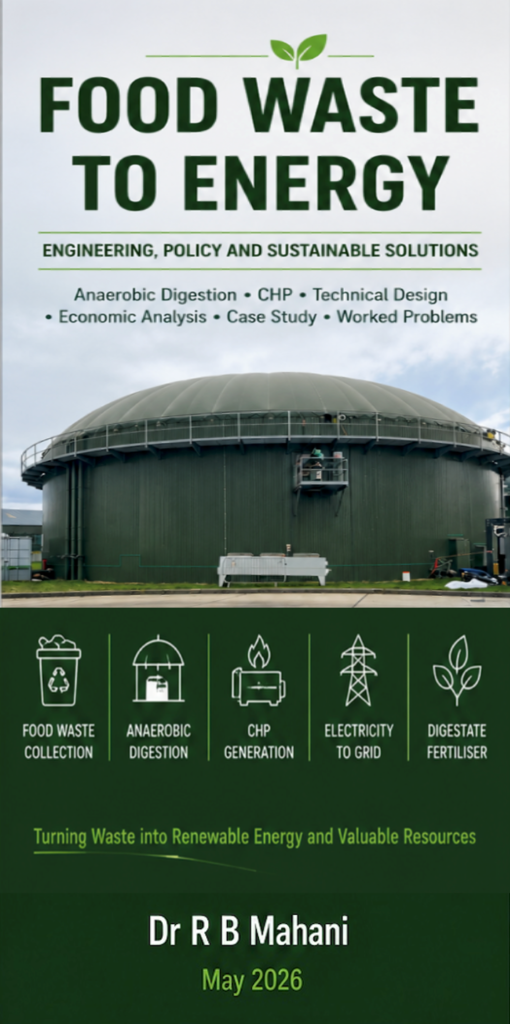
The central theme of this booklet is the transformation of food waste from an environmental burden into a valuable resource for renewable energy generation. In particular, it focuses on the role of anaerobic digestion (AD) as a key technology within modern waste management and sustainable energy systems. The content reflects both academic principles and real-world practice, aiming to bridge the gap between theory and industrial application.
The booklet covers the fundamental and applied aspects of anaerobic digestion systems, including the design and operation of digesters, biogas production processes, and the use of combined heat and power (CHP) units for electricity and heat generation. In addition, it introduces the relevant UK policies and regulatory frameworks that have driven the development of food waste collection and treatment systems, highlighting the importance of policy in shaping engineering solutions.
A distinctive feature of this work is the integration of a techno-economic analysis, enabling students to evaluate not only the technical performance of AD systems but also their economic viability. This includes considerations of capital and operating costs, electricity generation, and the role of incentives such as gate fees and energy tariffs.
To further enhance understanding, the booklet incorporates a case study based on a real anaerobic digestion facility in St Albans, providing practical insights into plant operation, energy generation, and system integration. This is complemented by a series of worked problems, designed to reinforce key engineering concepts such as mass and energy balances, biogas estimation, and heat recovery.
Importantly, the booklet adopts a systems-thinking perspective, encouraging students to view food waste management not as an isolated engineering problem, but as a complex system involving interactions between technology, economics, policy, and human behaviour. This holistic approach reflects the evolving role of chemical engineers in addressing global sustainability challenges.
It is hoped that this booklet will serve not only as a learning resource but also as a source of inspiration, demonstrating how core chemical engineering principles can be applied to real-world problems with significant environmental and societal impact.